
Index funds are popping up just about everywhere in conversations about personal finance. If you’ve ever started researching investing, you probably noticed people bringing up index funds way more than any single stock or fancy trading strategy.
Turns out, there’s a good reason for that, especially if you’re just starting out and looking for a hands-off, stress-free way to grow your money.
But if you’re like me when I started, you might feel a bit lost trying to untangle all the investing terms out there.
With stocks, index funds, and ETFs all floating around, things can get confusing fast. When I first learned about index funds, I wanted someone to break down what they are, how they work, and why so many beginners (and even a lot of the pros) say they’re the way to go.
This guide gives you a straight-up, straightforward look at index funds: what they are, how they work, why they’re generally loved by people new to investing, and the real pros and cons you’ll want to know.
My aim is to keep it as simple as possible, with zero complicated jargon and instead, lots of clear, relatable examples.

What Are Index Funds?
An index fund is simply a type of investment fund (think: giant pool of people’s money) that aims to match the performance of a specific market index, such as the S&P 500 in the US or the FTSE/JSE Top 40 in South Africa.
Rather than trying to pick the next big stock, index funds buy a small piece of every company in that index. This means that when you put cash in an index fund, you’re automatically invested in the entire list of companies tracked by that index.
The core idea is pretty easy: instead of betting on one company to win big, you’re investing in a slice of the entire market.
Index funds don’t try to outsmart the market or jump in and out of stocks based on predictions. They simply aim to copy whatever their chosen index does, for better or worse.
This style is a bit different from actively managed funds, where managers try to hand-pick stocks that they think will do better than the average.
With index funds, nobody is trying to “beat the market.”
They’re just matching it, which surprisingly has worked out better for most people over the long haul.
How Do Index Funds Work?
Index funds pool together money from a bunch of investors (that’s you, me, and everyone else who buys in).
The fund then divides this money across all the companies in a specific stock market index, following a preset formula. Everything is handled automatically. No one is in the background picking winners or tweaking the list based on hunches.
That means, if you own an index fund based on the S&P 500, your money is split across the 500 biggest companies in America.
You don’t get a say in which companies are included. The index fund makes sure you get a proportional slice of every company in the index, however large or small your investment.
This approach creates instant diversification, because you’re not placing all your bets on one business or sector.
Your returns come from two sources: the value of the companies in the fund growing (market growth), and any dividends those companies pay out. Over a long period, this mix benefits from compounding, where your gains keep reinvesting and building on themselves. That’s how index funds help regular people quietly build up serious wealth over time.
Recommended Reading: How Does Compound Interest Work For Savings?
Index Funds vs Individual Stocks
For a lot of beginners, picking individual stocks feels exciting, but it’s a lot to manage and comes with way more risk.
With a single company, if bad news hits, your whole portfolio might take a nosedive. Index funds lower the risk by spreading your money out across tons of different companies in one go.
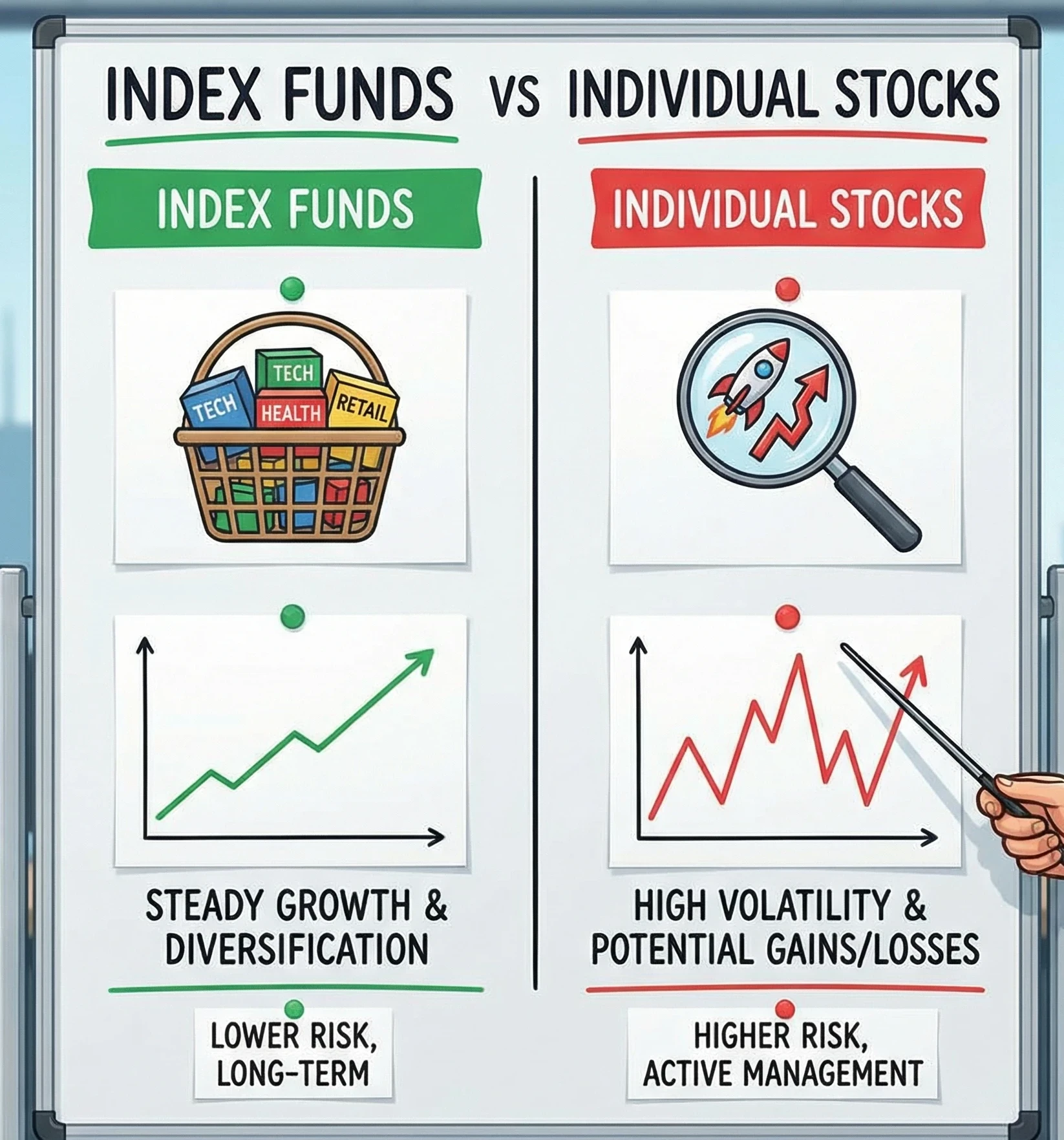
Investing in individual stocks takes a lot of time and skill.
You’ll want to research financial reports, keep up with the news, and check in constantly to avoid missing out on big swings. Even the pros make expensive mistakes here.
Index funds, on the other hand, generally have a smoother ride. While the value still goes up and down with the market, you’re protected from the crazy swings that can hit just one company or sector.
That’s a big reason most newbies and even many experienced investors choose index funds for the bulk of their portfolios. The peace of mind is pretty hard to beat, especially if you don’t live and breathe the stock market.
Types of Index Funds You Should Know
Not all index funds invest in the same things.
Here’s a rundown of the most common types:
- Stock Market Index Funds: These track popular stock indexes, like the S&P 500 or Nasdaq 100. Most beginners start here because these indexes cover a wide range of big, stable companies.
- Bond Index Funds: Instead of stocks, these track government or corporate bonds. They’re often used to stabilize your portfolio and lower overall risk.
- International Index Funds: These let you invest in companies outside your home country, helping you tap into global growth and avoid putting all your eggs in the same basket.
- Sector Based Index Funds: These focus on specific parts of the economy, like tech, healthcare, or energy. They can offer extra growth if you want to target certain trends, though they’re a bit riskier than broader funds.
- ESG/Ethical Index Funds: These funds pick companies based on environmental, social, or governance criteria. They’re popular with people who want their investments to match their values.
Benefits of Investing in Index Funds
There are a bunch of reasons index funds are so popular, especially among beginners and busy professionals:
- Low Fees: Because index funds are mostly run by computers with very little human intervention, they have lower fees than actively managed funds. Tiny differences in fees add up a lot over time, so this is a pretty big deal.
- Built In Diversification: You get a small piece of many companies (or bonds) in a single purchase. This spreads your risk and can lead to smoother returns.
- Passive Investing: You don’t have to constantly buy, sell, or watch charts. Once you’re in, it’s pretty much hands-off, so it’s super handy if you’re not interested in babysitting your investments.
- Strong Long Term Performance: History shows that broad index funds usually keep up with or even beat most professional managers over 10, 20, or 30 years.
- Beginner Friendly: The simplicity and reliability of index funds make them a solid choice if you’d rather spend your time living life, not studying finance.
Risks and Limitations of Index Funds
No investment is risk-free, and index funds do come with a few downsides:
- Market Downturns Will Still Hit: If the overall market takes a hit, your index fund will drop too. You can’t ‘hide’ in a bad year. You ride the ups and downs along with everyone else.
- No Outperformance: Index funds follow the average. If you’re looking to “crush” the market or find the next big thing, these probably aren’t for you. You’re aiming for steady growth, not lightning-in-a-bottle gains.
- Not Meant for Short Term Goals: Index funds are about the long haul. If you need your money in a year or two, the ups and downs could work against you.
- Still Needs Emotional Discipline: Seeing your balance dip can be tough. Successful index investing means not panicking and selling at the wrong time; patience is really important.
How Much Money Do You Need to Start Investing in Index Funds?
The cool thing about index funds is that you don’t need a massive pile of cash to get started.
Some traditional index funds have minimum investments (e.g., $500 or $1,000), but these days, many providers offer lower or even zero minimums, especially for index ETFs (Exchange Traded Funds) you can buy through most online brokerages. ETFs work a lot like index mutual funds but trade like stocks, usually letting you get started with as little as the price of one share.
Fractional investing, where you buy part of a share instead of a whole one, is also spreading fast, which lets you invest any amount, even if it’s just $5 or $10 at a time.
Monthly contributions, set on autopilot, can be a powerful way to build up your investment habit. In my experience, how often and consistently you invest is a lot more important than the exact dollar amount. Regular investing over time really pays off.
How Index Funds Help Build Long-Term Wealth
The real magic of index funds is in how they help build wealth slowly and steadily. When your returns and dividends are reinvested over years, you get the powerful “compound growth” effect.
Your money earns more money, and those new dollars start earning too. Even small early investments can snowball into something big given enough time.
Dollar cost averaging is another nifty benefit. This just means putting in a set amount of cash each month, no matter what’s happening in the stock market.
When prices drop, your money buys more shares. When prices are up, you buy fewer. Over time, the average cost per share usually smooths out, lowering your risk of bad timing. It’s a stress-free way to avoid needing to guess when the “perfect” moment is to invest (nobody ever gets it right all the time, not even the pros).
It’s important to keep your expectations realistic: index funds won’t turn you into a millionaire overnight.
It’s steady, patient growth, not a get-rich-quick move. But over the long haul, the combination of regular investing and compounding does a ton of the heavy lifting for you.
Are Index Funds Good for Beginners?
Index funds are a top pick for beginners, and honestly, for a lot of seasoned investors too.
They’re simple, low cost, and let you build a strong base even if you don’t know much about finance. If you’re just getting started, they let you skip the stress and confusion of choosing individual stocks.
A couple of beginner mistakes to watch out for: jumping in and out of the market based on headlines, skipping over fees, or assuming that past performance guarantees future results.
It’s also easy to want quick wins, but the real wins come from sticking with your plan, ignoring the noise, and letting time do the work.
If you ever feel totally lost or anxious, it’s always okay to ask for help from a professional adviser.
And above all, keep that long-term mindset.
That’s really important.
Shortcuts and hype are everywhere, but real growth comes from playing the long game and letting compounding work for you.
Final Thoughts. Should You Invest in Index Funds?
It’s easy to see why index funds are the go-to for so many beginners and experienced investors alike.
They keep costs low, simplify your portfolio, and quietly grow your money in the background while you live your life.
There are ups and downs, sure, but history shows that sticking with broad index funds over decades is a straightforward, proven way to build wealth.
One last bit of wisdom: take your time learning. You don’t have to become an expert overnight. The more you understand about money, investing, and how different income streams work, the more confident you’ll feel every time you put your money to work. And remember, your personal finance adventure is just that—your own ride. Be patient, stay informed, and keep building step by step.
Want to Learn How Wealth Is Really Built?
If you’re serious about understanding money, investing, and online income streams, I recommend starting with this free training bundle:
- 🎥 4 powerful masterclass videos by 7-figure earners (Value $499)
- 📘 A beginner-friendly affiliate marketing & income guide
- 🚀 Perfect for anyone who wants more control over their financial future
👉 Access the free training here
Wishing you everything of the best in your index fund investing journey.
Regards
Roopesh